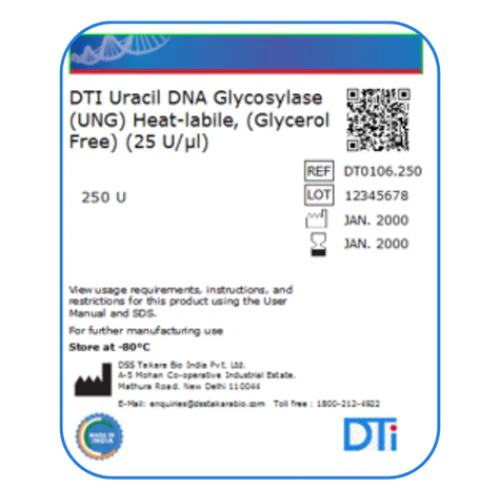
DTI UNG 25 U/µl - Glycerol Free
Components
Storage Buffer
Storage and Shipment Conditions: -80°C
Source: Produced in E. coli strain expressing a recombinant Xiphophorus maculatus UNG mutant.
Unit Definition: One unit of UNG is defined as the amount of enzyme required to digest 1 μg of uracil-containing dsDNA at 25℃ in 30 min.
Application: Used in further manufacturing and lyophilization processes for PCR, RT-PCR, and LAMP assays.
Inactivation by Heat: The enzyme is completely and irreversibly inactivated by heat incubating at 50℃ for 10 min.
Usage Protocol
• Use as per the requirement. Can be diluted if needed.
• Add suitable enzyme amounts based on application (typically 0.1 – 1 U/50μl reaction volume).
• UNG activation: Incubate for 10 min at 25℃.
• UNG inactivation: Incubate for 2 min at 95℃.
• Follow the specific protocol for application.
Quality Control Data: Please refer to the certificate of analysis for each lot.
DTI UNG 25 U/µl - Glycerol Free - Protocol and Downloads
Experimental Sample - Performance Data
qPCR reactions was performed with two qPCR reaction mix: One with UNG at a concentration of 2 U/ μl and other without UNG. Both these mixes were spiked with dU-containing amplicons, mimicking carryover contamination. The reaction mix without UNG generated a regular amplification curve, while the reaction mix containing UNG degraded the dU-containing amplicons resulting in significant reduction in amplification from the mimicking carryover contamination.