DTI offers a broad portfolio of reverse transcriptase enzymes and cDNA synthesis kits that can be used for a variety of applications, including first-strand synthesis, real-time PCR, and cDNA library construction.
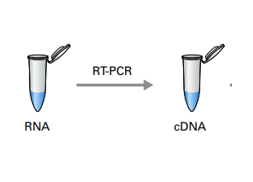
RT-PCR stands for Reverse Transcription Polymerase Chain Reaction. It’s a laboratory technique used to detect and measure RNA.
The process involves two main steps:
In RT-PCR, there are two main approaches: one-step and two-step. Each has its advantages depending on the experiment’s goals, RNA quality, and sample quantity.
One-Step RT-PCR: In a one-step RT-PCR, both reverse transcription (cDNA synthesis) and PCR amplification are performed in the same tube without transferring materials.
Two-Step RT-PCR: In a two-step RT-PCR, reverse transcription and PCR amplification are conducted separately. cDNA is synthesized first and can be stored or used for multiple PCR reactions.
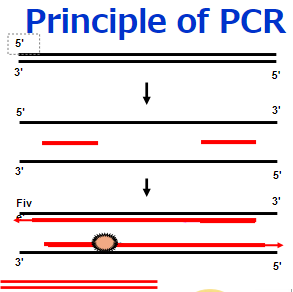
The principle of RT-PCR involves two main steps:


In this situation, we recommend using oligo-dT primers for two-step RT-qPCR rather than random 6-mers. The use of oligo-dT primers may improve efficiency and provide similar results as compared to one-step RT-qPCR.
For high-throughput analyses of many samples or precise detection of rare transcripts, a one-step RT-qPCR protocol is recommended. An additional advantage of one-step RT-PCR is the existence of single-tube workflows, avoiding the need to add additional reagents halfway through the procedure and thus lowering the risk of contamination.
Calibration curves for RT-qPCR may be prepared by either of the following methods:
Since the two methods evaluate different parameters, it is important to choose a method appropriate for the experimental system being used. Calibration curves prepared from diluted RNA samples reflect differences in not only PCR amplification efficiency, but also differences in reverse transcription efficiency, which is dependent on the amount of RNA. PCR amplification efficiencies determined from such calibration curves may potentially differ from the actual efficiency.
For Absolute Quantification, the reverse transcription efficiency is critical. Therefore, use serially diluted RNA to prepare calibration curves (cDNA dilution is unsuitable).
For Relative Quantification, differences in reverse transcription efficiency can be corrected by assaying a reference gene, such as a housekeeping gene. The use of serially diluted cDNA is recommended for preparing calibration curves.
To avoid amplification of genomic DNA in total RNA samples:
Target gene expression levels are often normalized to the expression of a “housekeeping gene” (reference gene) to correct for differences in the amount of input RNA and variations in reaction efficiency. How do I select a suitable housekeeping gene?
There is no single, universally appropriate housekeeping gene suitable for accurate normalization in every experimental condition, as it is important to select housekeeping genes that do not vary in expression levels in the experimental system used. Common housekeeping genes that have been used in the past include GAPDH and β-actin; however, reports in recent years indicate that expression of these genes may also vary, depending on the sample type and/or experimental conditions.
Using multiple housekeeping genes for normalization is currently the most reliable approach. In this strategy, the expression of multiple housekeeping genes is assayed, and the genes that show the lowest level of variation are selected for use. Software has been developed for selecting the optimum genes for correction (e.g., geNorm and BestKeeper). Inferences may also be made from microarray or RNA-seq expression profiling data, if available.

Suitable standard samples are those that approximate the actual sample as closely as possible. For gene expression analysis studies, use cDNA prepared from samples collected under conditions in which the target gene is known to be expressed. For genomic analysis studies, use genomic DNA.
Artificial standard samples (e.g., plasmid DNA) are not recommended. Even when the sequence of the amplicon is identical, any substantial difference in the template composition may result in variable PCR amplification efficiencies (e.g., genomic DNA vs. plasmid DNA).
When using a validated primer, previous melt curve analysis (Tm values) can serve as a reference. If the Tm value is the same as observed in the past, it is reasonable to assume that the PCR product is the same as that obtained in the past.
Keep in mind, however, that although identical PCR products will show the same Tm value, obtaining identical Tm values alone does not necessarily confirm that the PCR products are identical. An independent confirmation method should be used; when using a primer for the first time, please perform electrophoresis to confirm that the amplification product of the real-time PCR is the intended size.
The necessary number of sample replicates (n) varies depending on the experimental system. In principle, when the experimental error is expected to be relatively large, use a larger number of samples:
The sensitivity of qPCR varies depending on experimental conditions such as the reagents and primers used. Appropriately designed systems have demonstrated the ability to detect as few as ~10 copies of template.
The Ct value can be determined by two different methods:
Please note that some instrument systems do not allow one to choose between the crossing point method and the second derivative maximum method.