x
PCR Banner

Real Time(q)PCR

Our real-time qPCR reagents offer high performance, reproducibility, compatibility, and affordability, providing the right tools to advance your research, whether your experiments are routine or complex.

Upgrade Your Real Time (q)PCR Skills

What is Real Time PCR (q)PCR?
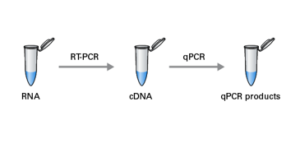
Real-time PCR (also known as quantitative PCR or qPCR) is a powerful and common technique for accurate analysis of gene expression. It is used to amplify and simultaneously quantify a targeted DNA molecule. Unlike traditional PCR, which involves running an electrophoresis gel at the end to visualize the amplified products, real-time PCR enables the detection and quantification of nucleic acids during the PCR process. This allows for the continuous tracking of the reaction’s progress and accurate quantification of the nucleic acids as they are being amplified.
Probe-based qPCR
Principle of probe-based qPCR

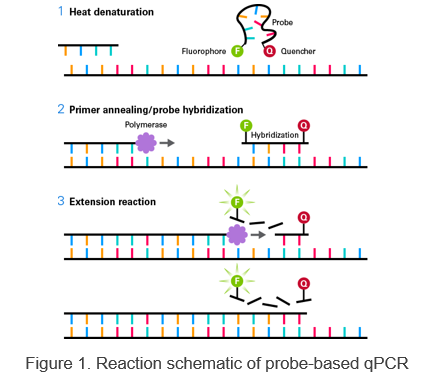
  • Oligonucleotides modified with a 5’ fluorophore (e.g., FAM) and a 3’ quencher (e.g., TAMRA) are added to the reaction. Under annealing conditions, the probe hybridizes in a sequence-specific manner to the template DNA. Fluorescence of the fluorophore is suppressed by the quencher. During the extension reaction, the 5’→ 3’ exonuclease activity of Taq DNA polymerase degrades the hybridized probe, releasing quencher suppression and allowing fluorescence (Figure 1). To maximize sensitivity, our kits use TaKaRa Ex Taq DNA Polymerase Hot-Start Version, a hot-start PCR enzyme that minimizes nonspecific amplification that may arise from mispriming or primer-dimer formation during reaction mixture preparation and pre-cycling steps.
Probe-based (q)PCR
Advantages and Disadvantages of Probe based qPCR
Advantages of Probe-Based qPCR:
  • The use of highly specific probes ensures accurate detection of target sequences with minimal interference.
  • Multiplexing Capability: Unique labeling of each probe allows for the simultaneous amplification of multiple targets in the same reaction tube, increasing throughput.
  • Multiplexing minimizes the need for multiple reactions, reducing the handling and preparation time of samples.
  • The probes can precisely discriminate between different single nucleotide polymorphisms (SNPs) and copy number variations (CNVs).

Disadvantages of Probe-Based qPCR:
  • Developing and optimizing probes can be time-consuming and may require several iterations to ensure specificity.
  • Probes, which include both a fluorophore and a quencher, are more expensive than simple oligonucleotide primers. Pre-designed probes can have even higher costs.
Principles of Green Intercalating Dye-Based qPCR
Fluorescent detection using intercalating dyes

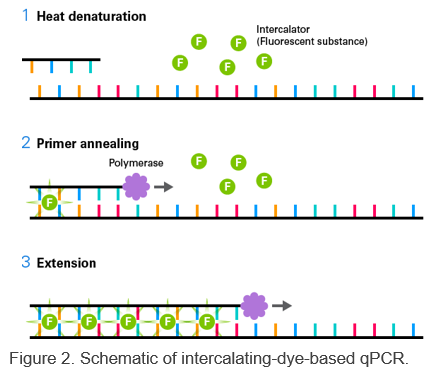
  • This method uses a DNA intercalator (e.g., TB Green) that emits fluorescence when bound to double-stranded DNA. Monitoring fluorescence allows for quantification of amplification products (Figure 1). Following amplification, performing a melt curve analysis provides information on the specificity of your PCR products. To maximize specificity and sensitivity, our kits use Takara Ex Taq DNA Polymerase Hot-Start Version, a hot-start PCR enzyme that minimizes nonspecific amplification that may arise from mispriming or primer-dimer formation during reaction mixture preparation and pre-cycling steps.
Intercalating-Dye-Based qPCR
PCR Principles
How do I calculate the melting temperature (Tm) of primers?
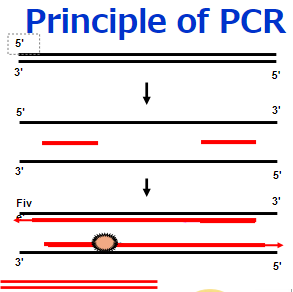
The primer melting temperature (Tm) is the estimate of DNA-DNA hybrid stability. Knowing the Tm is critical for determining an appropriate annealing temperature (Ta). A Ta that is too high will result in insufficient primer-template hybridization, leading to low PCR product yield. A Ta that is too low may lead to non-specific product amplification.

Calculation of the Tm of primers shorter than 20 bases can be performed using the Wallace rule: Tm = 2°C (A+T) + 4°C (G+C)
For accurate estimation of the Tm of primers longer than 20 bases, we recommend using free primer design software such as Primer3.
What primer concentration should be used for PCR?
The final concentration of each primer should be between 0.1 and 0.5 µM. A stock solution of each primer is typically 10–20 µM.
Primer concentrations that are too high increase the chance of mispriming, which may result in nonspecific amplification. Primer concentrations that are limiting can result in extremely inefficient amplification.
How should oligos be purified for PCR?
Standard desalted primers are satisfactory for most PCR applications.
Should I use a three-step pr a two-step PCR protocol?
Three-step PCR includes denaturation, annealing, and extension steps. This type of protocol should be used when the Tm of the primers is lower than the extension temperature or is less than 68°C.

If the melting temperature of the primer (Tm) is close to the extension temperature (72°C) or a few degrees lower, consider using a two-step PCR protocol that includes a denaturation step and a combined annealing/extension step. With this protocol, the annealing temperature should not exceed the extension temperature.
Which extension temperature should I use, 68° or 72°C
A 68°C extension temperature is preferred for two-step PCR and when amplifying longer templates (>4 kb). This lower extension temperature dramatically improves yields of longer amplification products by reducing the depurination rate that influences amplification.

72°C should be used as the extension temperature when performing three-step standard PCR and for amplification of short fragments (<4 kb).
What are the critical factors for amplification of GC-rich templates?
PCR conditions:
  1. Use higher denaturation temperatures (e.g., 98°C as opposed to 94°C or 95°C) to allow complete denaturation of the template.
  2. Keep annealing times for GC-rich templates as short as possible.
  3. Use primers with a higher Tm (>68°C), because annealing can occur at a higher temperature.